

Indianapolis Drug Crime Lawyer
What This Page Covers
- Indiana drug offenses, including possession, dealing, manufacturing, trafficking, paraphernalia, prescription fraud, operating a drug house, drug-impaired driving, conspiracy, and child endangerment.
- The five controlled-substance schedules and examples of drugs placed in each category.
- Charge levels ranging from misdemeanors to Level 1 felonies, with possible jail or prison time and fines.
- Sentencing factors such as the drug type and quantity, criminal history, location, firearm involvement, children, rehabilitation, and personal circumstances.
- Potential defenses, including unlawful search and seizure, lack of possession or knowledge, insufficient or missing evidence, a valid prescription, duress, and entrapment.
Why This Matters
- Even a small amount of a controlled substance can lead to serious criminal penalties in Indiana.
- The substance, amount, charge level, prior record, and facts of the incident can substantially change the possible sentence.
- A conviction may result in jail or prison, probation, electronic monitoring, community corrections, and fines.
- A felony record can affect voting rights during the sentence, firearm rights, jury service, employment options, and financial stability.
- Early review of the evidence can uncover problems with a search, laboratory work, possession allegations, or the prosecution’s proof.
Key Actions You Can Take
- Get legal advice early so you understand the exact charge, possible penalties, and deadlines in your case.
- Keep copies of charging documents, bond paperwork, search warrants, prescriptions, and messages related to the allegations.
- Write down a private timeline of the incident, including where the substance was found and who had access to the location.
- Follow every court and bond requirement, and avoid discussing the case publicly or posting about it online.
- Schedule a consultation to review the evidence, possible defenses, and any treatment or mitigation steps that may help.
If you are facing drug charges in Indiana, you likely know that a conviction can have serious consequences. Whether you’re facing allegations of illegal possession, distribution, or drug trafficking, defending yourself is challenging and exhausting. A Zentz Law Indianapolis Drug Crime Lawyer helps people fight drug charges.. We are here to help you.
What Offenses Warrant a Drug Charge in Indiana?
In Indiana, there are dozens of separate offenses that can lead to drug possession charges, including:
- Constructive Possession/Simple Possession/Actual Possession: Holding an illegal substance for personal use or distribution on your person or
 your property is considered controlled substance possession.
 - Drug Dealing: Selling or transferring controlled substances to others.
- Manufacturing: Producing certain controlled substances, such as methamphetamine or other illegal drugs.
- Drug Trafficking: Transporting controlled substances across state or national borders.
- Possession of Drug Paraphernalia: Possessing equipment or materials used for manufacturing, packaging, or using drugs.
- Prescription Drug Fraud: Obtaining or distributing prescription drugs unlawfully, such as through forging prescriptions or getting prescriptions from more than one practitioner’s professional practice.
- Operating a Drug House: Maintaining a property used for manufacturing, distributing, or using drugs.
- Driving Under the Influence (DUI) of Drugs: Operating a vehicle while under the influence of drugs.
- Conspiracy: Planning or conspiring with others to commit drug crimes, including a practitioner acting as a supplier.
- Child Endangerment: Engaging in drug-related activities in the presence of minors or exposing them to harmful substances.
 your property is considered controlled substance possession.
Life-changing drug charges can result from one or two separate offenses, ranging from misdemeanors to felonies.
How Does Indiana Categorize a Controlled Substance?
A controlled substance is defined under Indiana Code 35-48-1-9 as any “drug, substance, or immediate precursor in Schedule I, II, III, IV, or V.”
These schedules include the following broad categories of drugs:
Schedule I — Substances like heroin, marijuana, ecstasy, and LSD have the highest potential for abuse and addiction.
Schedule II — Opioid painkillers and stimulants like cocaine, crack, methamphetamine, and PCP possess a high risk for abuse and addiction but have some legal medical uses.
Schedule III — Low doses of codeine, anabolic steroids, and ketamine have a moderate potential for abuse and addiction yet are recognized for their accepted medical applications.
Schedule IV — Medications such as Ambien, Xanax, Valium, and Darvocet are characterized by a low risk of abuse and addiction, coupled with recognized medical use.
Schedule V — This category comprises substances with the least potential for abuse and addiction compared to other schedules while still maintaining recognized medical utility.
Zentz Law Indianapolis Defense Attorneys are here to help. Contact today for a evaluation.
What Happens When People Are Convicted of Drug Crimes?
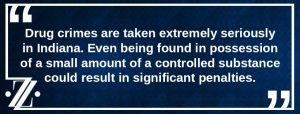 Drug crimes are taken extremely seriously in Indiana. Even being found in possession of a small amount of a controlled substance could result in significant penalties.
Penalties for drug offenses hinge on several factors, including the drug involved and the amount of the drug, your criminal background, and the specifics of the incident.
Convictions can mean jail time, probation, fines, and even prison time for more serious offenses.
Here’s a general breakdown of the categories of an Indianapolis drug crime class and correlating penalty:
Class B Misdemeanor Drug Crime
| Level 4 Felony Drug Crime
|
Class A Misdemeanor Drug Crime
| Level 3 Felony Drug Crime
|
Level 6 Felony Drug Crime
| Level 2 Felony Drug Crime
|
Level 5 Felony Drug Crime
| Level 1 Felony Drug Crime
|
Additional Consequences of Felony Drug Convictions
Indiana has three levels of felonies depending on the severity of the drug crimes: Level 1, Level 2, and Level 3.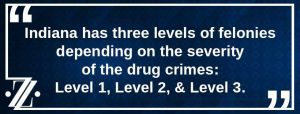
A conviction for any felony level may result in various sentences, such as prison time, electronic home detention, community corrections (house arrest), or probation.
In addition to those consequences, having a drug-related felony on your permanent criminal record can have a devastating impact on a person’s life.
Some of the post-incarceration consequences of a drug felony include:
- Unable to vote until all terms of their sentence (including probation) have been met.
- Inability to legally own or carry firearms.
- Unable to serve on a jury.
- Job restrictions (unable to work with children, in banks, or as law enforcement officers).
- No social security contributions while incarcerated makes it difficult to get disability or social security payments.
Are There Any Special Circumstances That Impact Sentencing?
In addition to the sentencing factors above, some conditions will increase or decrease the severity of your sentence.
Circumstances that may lead to more severe punishment:
- Quantity of Drugs: The amount of drugs involved can significantly impact your sentence. More drugs typically lead to harsher penalties.
- Class of Drugs: Serious drugs like cocaine, heroin, ecstasy, and LSD lead to severe sentencing.
- Role of the Defendant: When Indianapolis drug crimes involve others, like a drug trafficking ring or organized crime, the higher the responsibility the greater the punishment.
- Location of Drug Crime Cases: Additional penalties can be added to the basic charges if the crime occurred near a school, public park, school bus, or public housing.
- Involvement of Children: Severe penalties can be levied when drug crimes occur when children are present or if a minor is coerced to participate.
- Use of a Firearm: Possessing a firearm during drug crimes brings additional consequences.

Circumstances that can lead to less severe punishment, even though some of the same circumstances that would normally require serious penalties:
- Rehabilitation Efforts: Showing progress in personal growth or overcoming addiction through programs like drug treatment or counseling can lead to a more lenient sentence.
- Personal Circumstances: Factors like mental health challenges, financial difficulties, or family responsibilities contributing to the offense may lessen culpability and result in reduced sentencing.
- Clean Criminal Record: The legal system can consider a lack of prior convictions favorably and may result in a lighter sentence.
- Other Justifying Factors: Cooperation with Indiana law enforcement officials, expressing remorse, or making positive contributions to the community can also create a more favorable outcome.
At Zentz Law, we are criminal defense lawyers and we want to help you understand the possible consequences of your drug charges, contact us today.
How Can Skilled Indianapolis Drug Crime Lawyers Help?
The state has to prove its criminal case to convince the courts a conviction is warranted. Defense attorneys will challenge the criminal charges by identifying evidence gaps, errors by the arresting officer or drug crime lab, and any constitutional rights violations.
Some of the strategies your Indianapolis drug crime lawyer may use to defend you include:
- Unlawful search & seizure: Challenging unlawful search and seizure involves arguing that law enforcement violated your Fourth Amendment rights by conducting an illegal search or seizure, rendering any evidence obtained inadmissible in court.
- Drugs do not belong to you/Lack of possession: Asserting that the drugs do not belong to you or demonstrating a lack of possession casts doubt on your culpability in the alleged drug crimes.
- Unwitting possession: Claiming unwitting possession entails asserting that you were unaware of the illicit nature of the substance or that it was in your possession, possibly due to factors such as misplaced items or manipulation by others
- Not a controlled substance: Arguing that the substance in question is not a controlled substance involves challenging the prosecution’s claims regarding the substance, potentially leading to the dismissal of the drug crime charges.
- Missing evidence: Citing missing evidence involves highlighting the prosecution’s failure to prove guilt beyond a reasonable doubt.
- Immunity: Seeking immunity involves negotiating with authorities for immunity from prosecution in exchange for providing valuable information or cooperation in an investigation.
- Duress/Coercion: Claiming you were forced or coerced into the drug-related offense under threat of harm may serve as a mitigating factor in your drug crime defense.
- Insufficient evidence: Contesting insufficient evidence involves challenging the prosecution’s case by demonstrating a lack of probable cause.
- Prescription defense: This involves demonstrating you possess drugs legally with a valid prescription from a licensed healthcare provider, negating any criminal intent or wrongdoing.
- Entrapment: Claiming entrapment involves asserting that law enforcement induced or encouraged you to commit the drug-related offense, which may serve as a drug crime defense if you can prove that you were not predisposed to commit drug crimes.
- Planted drugs: Asserting that the drugs were planted involves alleging that law enforcement unlawfully planted the drugs on your person or property.
 cooperation in an investigation.
If you have questions about whether a criminal defense may potentially apply to your case, contact Zentz Law for a consultation.
Don’t Wait, Schedule a Free Case Evaluation from an Indianapolis Drug Crime Attorney
If you have been charged with a drug-related offense, the time to hire a skilled Indianapolis drug crime lawyer is now. From the very beginning of the legal process, we will build comprehensive criminal defense strategies to help you fight back.
You deserve a quality legal team that has your back. Zentz Law stands ready to help: 317-220-6056.
Indianapolis Drug Crime Lawyer FAQs
What happens at an arraignment after an Indiana drug arrest?
At the arraignment, the judge states the charge and you enter a plea. Bail may also be set or reviewed at this stage.
Can an Indiana drug case be resolved through diversion or alternative sentencing?
Possibly. Eligible cases may involve a diversion program, probation, community service, or substance abuse treatment. Completing diversion may allow you to avoid a conviction, but eligibility depends on the facts and local program rules.
Can a felony drug charge be reduced to a misdemeanor?
Potentially. The evidence, your history, the seriousness of the charge, and plea negotiations may support a reduction from a felony to a misdemeanor. A reduction is not guaranteed.
Does every Indiana drug charge go to trial?
No. A case may end through dismissal, a successful pretrial motion, diversion, or a negotiated plea. A trial is needed when the case cannot be resolved another way.
When can an Indiana drug case involve federal court?
Drug possession and related conduct can violate both Indiana and federal law. If federal authorities file charges, the case may proceed in federal court rather than state court.
Can bail be reduced after a drug-related arrest in Indiana?
Yes. Your lawyer may request a bond reduction at the first court appearance or through a formal hearing. The judge may consider the charge, flight risk, community safety, local ties, employment, and criminal history.
Can a defense lawyer help before formal drug charges are filed?
Yes. Early legal guidance can help you understand the investigation, protect your right to remain silent, and prepare for possible charges before your first court appearance.
How long can a drug case take in Marion County?
A misdemeanor may take about two to six months, while a complex felony may take six months to more than a year. The evidence, court schedule, negotiations, and whether the case goes to trial can change the timeline.
Can an Indiana drug possession conviction be expunged?
Some arrests and convictions may qualify for expungement under Indiana’s Second Chance laws. Eligibility and waiting periods depend on the record, the offense, new charges, and completion of court-ordered requirements.
How can a drug conviction affect housing or education opportunities?
A drug conviction can create barriers to employment, housing, professional licensing, and educational opportunities. The effects depend on the conviction and the rules used by the employer, school, licensing board, or housing provider.